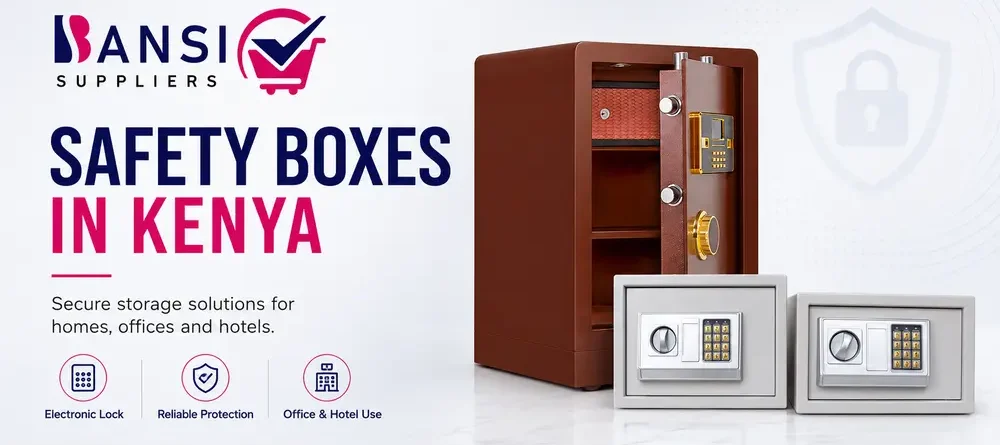
When buying a safe, one of the first decisions is whether to choose a digital safe box or a key lock safe box.
Both can provide controlled storage for cash, documents, keys and valuables, but they use different access systems and create different management requirements.
A digital safe normally uses an electronic keypad, PIN or another electronic access method. A key-lock safe relies on a physical key.
Neither lock type is automatically right for every buyer.
The appropriate choice depends on:
- How frequently the safe will be opened
- Number of authorised users
- Whether you want electronic access
- How keys or codes will be controlled
- What happens if access credentials are lost
- Battery requirements
- Backup-access method
- Where the safe will be used
- The overall specification of the safe itself
For currently available products, browse our Safe Boxes in Kenya category.
Digital Safe Box vs Key Lock Safe Box at a Glance
| Feature | Digital Safe Box | Key Lock Safe Box |
|---|---|---|
| Main access | Electronic keypad/PIN depending on model | Physical key |
| Batteries | Usually required | Not required for a basic mechanical key lock |
| Physical key for normal use | Often unnecessary | Required |
| Backup access | Depends on model | Spare key arrangements depend on model |
| Multiple users | Codes may be shared or managed depending on model | Requires control of keys/copies |
| Main management issue | Codes, batteries and backup access | Key storage, loss and duplication |
| Frequent access | Can be convenient | Can also work if the key is easily managed |
| Power dependency | Electronic system requires power | Basic key mechanism does not |
| Fire resistance | Separate specification | Separate specification |
| Security level | Depends on complete safe specification | Depends on complete safe specification |
The lock is only one part of the safe.
Construction, installation, dimensions and documented security or fire ratings may be just as important.
What Is a Digital Safe Box?
A digital safe box uses an electronic locking mechanism.
Depending on the particular model, access may involve:
- PIN code
- Electronic keypad
- Digital display
- Biometric fingerprint reader
- Keypad plus fingerprint
- Electronic access with backup key
Digital safes are often considered where the safe needs to be opened regularly and users prefer not to rely on the primary physical key for normal access.
For a detailed guide, visit our Digital Safe Box in Kenya page.
What Is a Key Lock Safe Box?
A key-lock safe uses a physical key to operate its locking mechanism.
It does not normally require:
- Batteries
- PIN codes
- Electronic programming
- Electronic reset procedures
This can make operation straightforward.
However, the key becomes an important part of the security system.
You need to decide:
- Who holds it
- Where it is kept
- Whether a spare exists
- Who can access the spare
- What happens if it is lost
- Whether unauthorised copies could be made
A simple lock does not eliminate access-management requirements; it changes them.
How Does a Digital Safe Work?
The exact operating method varies by manufacturer and model.
A typical electronic safe may require the user to:
- Enter a PIN.
- Confirm the code.
- Allow the electronic locking mechanism to release.
- Turn a handle or knob where applicable.
Some models may also provide:
- Low-battery warning
- Incorrect-code lockout
- Internal reset button
- Override key
- External emergency power connection
- Fingerprint access
Do not assume these features are included unless they appear in the exact product specification.
How Does a Key Lock Safe Work?
A basic key-lock safe uses a mechanical key to unlock the door.
This avoids dependence on an electronic keypad or battery.
However, losing the key can create a significant access problem.
Key control therefore matters just as much as PIN control matters with an electronic safe.
Digital Safe Advantages
A digital safe may provide several practical advantages depending on the model and user.
No Primary Key Needed for Normal Access
Users can normally access the safe using an electronic credential such as a PIN.
That reduces the need to retrieve and return a physical key each time the safe is opened.
Codes May Be Changeable
Many electronic models allow the access code to be updated.
This can be useful if:
- An employee changes role
- A user should no longer have access
- A hotel guest checks out
- You suspect a code has been shared
Confirm the actual code-management features on the model.
Practical for Frequent Access
Digital access can be convenient where authorised users open the safe repeatedly during normal operations.
Examples might include:
- Offices
- Hotels
- Shops
- Reception desks
- Service businesses
Multiple-User Applications
Some organisations may find code-based access easier to manage than handing a physical key between multiple authorised people.
However, sharing one code with many people can reduce accountability.
Where user-specific codes are required, confirm that the safe actually supports them.
Digital Safe Disadvantages to Consider
Electronic access also creates additional considerations.
Batteries Are Required
Most digital locks depend on batteries.
You need to know:
- Battery type
- Expected replacement procedure
- Low-battery indication
- Where batteries are installed
- What happens when they run out
A Code Can Be Forgotten
A forgotten PIN may prevent normal access.
Check the recovery or override process before buying.
Codes Can Be Shared
A digital code can be communicated to another person.
Businesses should have a policy covering who is allowed to know or change it.
Electronic Components Vary by Model
Keypads, displays and locking electronics differ between products.
Do not assume all digital safes offer identical reliability or features.
Key Lock Safe Advantages
A traditional key lock can also be appropriate depending on the application.
No Electronic Battery Requirement
A basic mechanical key lock does not rely on batteries for normal operation.
Straightforward Operation
Insert the correct key and operate the lock according to the safe design.
There is no PIN to remember.
Suitable for Restricted Single-User Access
A key system can work well where one responsible individual controls the safe and the key.
No Electronic Programming
There is no code setup, keypad configuration or electronic reset procedure.
Key Lock Safe Disadvantages to Consider
Key systems have their own access risks.
Keys Can Be Lost
If the only authorised key is lost, accessing the safe may become difficult.
Keys Can Be Misplaced
This can delay access even when the safe itself is functioning correctly.
Physical Keys Can Be Shared
Giving another person the key provides them with physical access.
Additional Copies Need Control
If duplicate keys exist, you should know:
- How many there are
- Who has them
- Where spare keys are stored
What Happens If a Digital Safe Battery Dies?
This depends on the specific safe.
Possible manufacturer-designed arrangements can include:
- Override key
- External emergency power point
- Accessible external battery compartment
- Another emergency-opening system
Never assume your model includes one of these methods.
Before buying a digital safe, ask:
“How do I access this exact model if the batteries are completely flat?”
That answer should be clear before purchase.
Where Should the Backup Key Be Stored?
If your digital safe has a mechanical override key, do not undermine the backup system by storing the key inside the locked safe.
The backup key should be stored separately in a controlled location.
Businesses should also define who is authorised to hold it.
What Happens If You Lose the Key to a Key-Lock Safe?
The solution depends on the safe and manufacturer.
Possible next steps may involve:
- Locating an authorised spare
- Checking manufacturer documentation
- Contacting the supplier
- Using an appropriate locksmith where necessary
Avoid forcing or drilling the safe without first determining the correct procedure.
Digital Safe vs Key Safe for Office Use
An office can use either system.
The decision should depend on workflow.
A Digital Safe May Suit an Office Where:
- The safe is accessed regularly
- More than one authorised employee requires access
- Codes need to be changed when responsibilities change
- Physical key handling would be inconvenient
A Key Safe May Suit an Office Where:
- One designated person controls access
- The safe is accessed occasionally
- Management prefers mechanical operation
- Key storage can be tightly controlled
For a broader workplace guide, see Office Safe Box in Kenya.
Digital vs Key Safe for Petty Cash
For petty cash, the access procedure matters as much as the lock type.
A business should consider:
- Who receives the cash
- Who can open the safe
- Who keeps records
- How frequently the safe is opened
- How access is audited
- What happens when the responsible employee is absent
A digital safe can reduce the need to transfer a physical key, while a key lock can work effectively where access is tightly limited to one custodian.
The safe does not replace good cash-control procedures.
Digital vs Key Safe for Home Use
Either can work at home.
Digital May Suit You If:
- You prefer PIN access
- Several trusted household members need access
- You open the safe regularly
- You do not want to use the primary key each time
Key Lock May Suit You If:
- You prefer mechanical operation
- One person controls access
- The safe is opened infrequently
- You want to avoid battery management
The right choice depends on your household rather than a universal rule.
Digital Safe vs Key Safe for Hotels
Hospitality use introduces different requirements.
For a guest-room safe, consider:
- Ease of setting a temporary code
- Code reset between guests
- Authorised management override
- Battery replacement
- Backup opening procedure
- Internal dimensions
- Installation or anchoring
A basic key-lock safe may be less convenient for individual hotel guests if keys must be issued and managed, but the exact operating model should determine the choice.
Digital vs Key Safe for Shops
Retail environments may require repeated access to:
- Cash
- Receipts
- Keys
- Important documents
A digital safe may simplify regular authorised access, while a key safe can work where one person controls the cash-storage process.
For significant cash-handling requirements, also determine whether you need a more specialised cash or deposit-safe design rather than just choosing between digital and key access.
Which Is Better for Documents?
Lock type does not determine whether the safe is suitable for document protection.
Both electronic and key-lock safes may store documents if:
- Internal dimensions are suitable
- Access control is appropriate
- Construction meets the required specification
If you require fire-resistant document storage, that is a separate decision.
See our Fireproof Safe Box in Kenya guide.
Is a Digital Safe More Fireproof Than a Key Safe?
No.
A digital lock does not establish fire resistance.
Neither does a mechanical key lock.
Fire resistance should be supported by the specification of the complete safe, such as:
- Manufacturer fire rating
- Relevant test standard
- Rated duration
- Conditions covered by the test
- Intended contents
The current Bansi Safe Box category includes different types of safes, so buyers should verify model-specific claims rather than assuming that the lock type determines protection.
Is a Key Safe More Secure Than a Digital Safe?
Not necessarily.
The locking method is only one part of physical security.
Consider:
- Safe construction
- Lock design
- Door structure
- Anchoring
- Installation
- Manufacturer specification
- Applicable security rating where available
A poorly specified safe does not become highly secure simply because it uses a key.
The same applies to digital locks.
Is a Digital Safe More Secure Than a Key Safe?
Again, not automatically.
Electronic access may provide useful operational features, but the keypad itself does not determine the overall security level of the safe.
Compare complete products rather than lock types in isolation.
Code Management vs Key Management
This is one of the most useful ways to think about the decision.
With a Digital Safe, You Manage:
- PINs
- Code changes
- Authorised users
- Batteries
- Override access
- Electronic reset procedures
With a Key Safe, You Manage:
- Physical keys
- Spare keys
- Key holders
- Lost keys
- Key copies
- Key storage
Both systems require responsible access management.
What Happens When an Employee Leaves?
This is especially important for companies.
Digital Safe
If the employee knew the code, change the access code according to the manufacturer’s procedure.
Key Safe
If the employee had a key:
- Recover the key
- Confirm whether copies may exist
- Consider the organisation’s appropriate lock/key-control procedure
Access management should form part of employee handover procedures.
Can Several People Share One Digital Safe Code?
They can technically share a code on many models, but this may make it difficult to determine who accessed the safe.
Where individual accountability is important, look for a model that supports suitable user-management functionality rather than simply sharing one code.
Does a Digital Safe Need Electricity?
Digital safes commonly use batteries rather than a permanent mains electricity supply.
However, the exact power system depends on the model.
Confirm:
- Battery type
- Battery quantity
- Replacement method
- Low-battery warning
- Emergency access
Does a Key Lock Safe Ever Need Batteries?
A standard mechanical key lock generally does not need batteries to operate.
However, some safe products may combine mechanical and electronic systems.
Always check the specific model.
What About Biometric Safe Boxes?
A biometric safe is generally another form of electronic-access safe.
Instead of relying only on a PIN, selected models may use fingerprint recognition.
Possible considerations include:
- Fingerprint enrolment
- Number of supported users
- Sensor operation
- Batteries
- Backup PIN
- Override key
- Reset procedures
Read our Digital Safe Box in Kenya guide for more information about electronic access options.
Digital vs Key Safe Box Prices in Kenya
Pricing depends on much more than lock type.
Important factors include:
- Size
- Internal capacity
- Construction
- Weight
- Lock specification
- Electronic features
- Shelves or compartments
- Mounting features
- Manufacturer
- Documented protection ratings
- Quantity
A basic digital safe can cost less than a larger premium key-lock safe, so it would be inaccurate to assume that every digital safe is more expensive.
For current price-focused information, see Safe Box Price in Kenya.
Common Mistakes When Comparing Digital & Key Safes
Avoid these mistakes:
- Assuming digital automatically means more secure
- Assuming key locks automatically mean more reliable
- Ignoring internal dimensions
- Forgetting battery management
- Not checking backup access
- Keeping an override key inside the safe
- Sharing the PIN with too many users
- Failing to control spare keys
- Ignoring installation
- Choosing only on price
- Assuming lock type determines fire resistance
- Ignoring the specification of the complete safe
Digital vs Key Safe Decision Checklist
Choose based on these questions:
Access
- How often will I open the safe?
- How many people need access?
- Do I prefer a PIN or physical key?
Digital Management
- Who controls the PIN?
- Can the PIN be changed?
- What happens if the battery fails?
- Is there backup access?
Key Management
- Who holds the primary key?
- Is there a spare?
- Where will the spare be stored?
- What happens if the key is lost?
Storage
- What will I put inside?
- What internal dimensions do I need?
- Will the requirement grow?
Protection
- Do I need fire resistance?
- Is a documented security rating required?
- Is mounting necessary?
So, Which Should You Choose?
Choose based on the way the safe will actually be managed.
A digital safe box may suit buyers who value electronic access, regular use and easier code changes.
A key-lock safe may suit buyers who prefer a straightforward mechanical lock and can tightly control the physical key.
Neither choice should be made in isolation from the rest of the safe specification.
Before purchasing, compare:
access system + construction + dimensions + capacity + installation + protection requirements.
Browse Safe Boxes in Kenya
Once you know which locking system fits your needs, browse our Safe Boxes in Kenya category.
If you specifically want electronic-access options, read Digital Safe Box in Kenya.
For workplace requirements, visit Office Safe Box in Kenya.
For fire-resistance requirements, visit Fireproof Safe Box in Kenya.
For pricing, visit Safe Box Price in Kenya.
For broader product selection guidance, read How to Choose a Safe Box in Kenya.
For company, institutional or bulk requirements, Request a Quotation.
Bansi Suppliers — Source. Supply. Succeed.
Frequently Asked Questions
Is a digital safe box better than a key lock safe?
Not universally. Digital access may be more convenient for some users, while mechanical key access may suit others. Compare access frequency, number of users, battery management, key management and the complete safe specification.
What happens if a digital safe battery dies?
The recovery procedure varies between models. Some provide an override key or emergency power method. Confirm this before purchasing.
What happens if I forget my digital safe code?
Follow the manufacturer’s recovery procedure for the specific model. Do not assume all electronic safes use the same reset method.
What happens if I lose the key to my safe?
Check for an authorised spare and consult the product documentation, supplier or an appropriate locksmith where necessary.
Can two people use the same digital safe?
Potentially, depending on the model and access procedure. Businesses should consider how shared credentials affect accountability.
Which lock is better for an office safe?
Either can work. Digital access may suit frequent authorised access, while key access may suit an office where one designated person controls the safe.
Which lock is suitable for home use?
Both can be suitable. Choose according to preferred access method, frequency of use and how reliably you can manage the key or code.
Is a digital safe automatically fireproof?
No. Digital access and fire resistance are separate specifications.
Does a key lock make a safe burglar-proof?
No. The overall security level depends on the complete safe construction, locking system, installation and documented ratings where applicable.
Are biometric safes digital safes?
Biometric safes are electronic-access safes that may use fingerprints. Some models combine biometric, PIN and backup-key access.
Are digital safes more expensive than key safes?
Not necessarily. Price depends on the complete product specification, including size, construction, capacity and features.
Where can I compare safe box prices in Kenya?
Visit our Safe Box Price in Kenya page.
Where can I buy digital and key-lock safes in Kenya?
Browse the Bansi Suppliers Safe Box category and check the individual product’s locking specification before ordering.