Choosing gloves for a food-handling operation should not be based on price alone.
The right glove depends on:
- Whether workers touch exposed food
- How long the task takes
- Whether the work is wet or dry
- How much grip and finger control are needed
- How often gloves must be changed
- The food-contact information supplied with the product
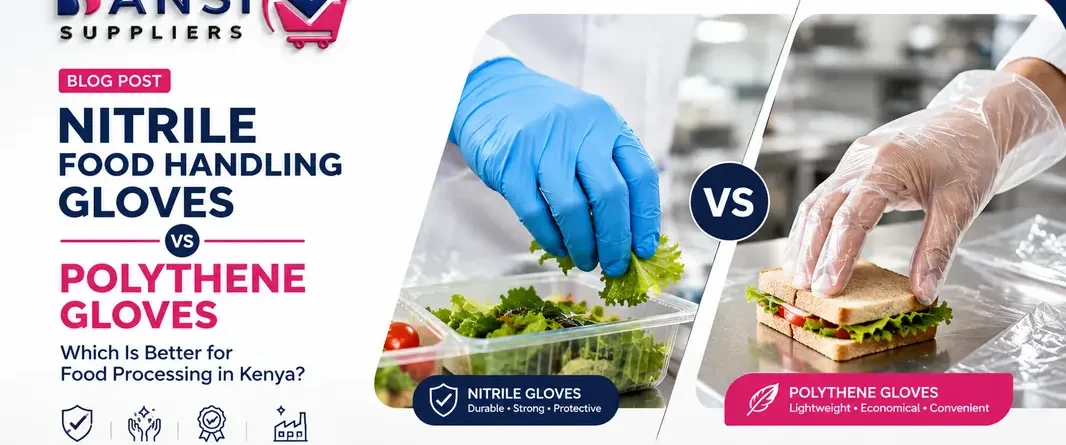
Two common options are nitrile food-handling gloves and polythene gloves. Both can have a place in food-processing and catering environments, but they are suited to different tasks.
For work requiring a closer fit, better finger control and a more continuous barrier, nitrile food-handling gloves may be the better option.
For quick, low-risk duties where workers need to change gloves frequently, disposable polythene gloves may offer a simpler and more economical solution.
Quick Comparison
| Factor | Nitrile food-handling gloves | Polythene gloves |
|---|---|---|
| Fit | Close-fitting | Loose-fitting |
| Dexterity | Generally better | Limited for detailed work |
| Grip | Better for controlled handling | Suitable mainly for simple tasks |
| Wet work | More practical for suitable wet tasks | Can become loose during wet handling |
| Puncture and tear performance | Generally stronger, depending on thickness | Intended mainly for light-duty use |
| Glove changes | Suitable for longer individual tasks | Practical for frequent changes |
| Typical use | Food preparation, portioning and processing | Serving, bakery counters and short handling tasks |
| Cost per glove | Usually higher | Usually lower |
| Food-contact suitability | Must be confirmed | Must be confirmed |
Actual performance varies by thickness, fit, material formulation and manufacturer specifications. A glove should not be approved for direct food contact solely because it is labelled nitrile or polythene.
What Are Nitrile Food-Handling Gloves?
Nitrile gloves are disposable gloves manufactured from synthetic rubber.
They commonly provide a close fit around the hand and fingers, making them practical for tasks that require:
- Dexterity
- Controlled grip
- Repeated hand movement
- Handling wet or oily food
- Longer periods of use
- Protection from minor splashes and food residues
Bansi Suppliers provides food-handling gloves in Kenya for food processors, commercial kitchens, bakeries, hotels, catering companies and other workplaces requiring hygienic hand protection.
Nitrile is also widely used as an alternative to natural latex. However, glove formulation and performance differ between products, so buyers should confirm the exact glove specification before purchasing. NIOSH research notes that disposable nitrile gloves are commonly used as physical and chemical barriers, while also emphasising that performance varies between glove brands and formulations. (CDC Stacks)
What Are Polythene Gloves?
Polythene gloves are lightweight disposable gloves commonly used for short food-handling and service tasks.
They are usually loose-fitting and easy to put on and remove. This makes them practical where employees must change gloves repeatedly during the working day.
Polythene gloves may be considered for:
- Handling bakery products
- Serving ready-to-eat food
- Packing dry food
- Handling sandwiches
- Portioning simple food items
- Short-duration catering tasks
- Food sampling
- Handling lightweight ingredients
- Tasks requiring frequent glove replacement
Their loose fit makes them less suitable for work requiring precise finger movement, a secure grip or extended handling of wet products.
Nitrile Gloves vs Polythene Gloves for Food Handling
The best glove depends on the actual job being performed.
Nitrile Gloves Provide a Closer Fit
Nitrile gloves normally fit more closely around the fingers and palm.
This can make them more suitable for:
- Cutting and preparing ingredients
- Handling smaller food items
- Decorating baked products
- Portioning food
- Handling meat or fish
- Packing products accurately
- Working with food-processing equipment
A closer fit can help employees maintain better control during detailed work.
Polythene Gloves Are Easier to Change
Polythene gloves are generally quick to put on and remove.
They may be useful where workers perform short tasks and need to change gloves frequently, such as:
- Serving bakery items
- Moving between customers
- Handling ready-to-eat food briefly
- Packing dry snacks
- Providing food samples
- Handling one product before changing duties
Food-safety guidance recommends using single-use gloves for one task and discarding them when they become damaged, dirty or when the task is interrupted.
Nitrile Gloves Are Better for Dexterity
Nitrile food-handling gloves are generally the better choice where workers need controlled finger movement.
Examples include:
- Food preparation
- Ingredient measuring
- Meat portioning
- Bakery decoration
- Delicate packaging
- Fruit cutting
- Handling small production components
Loose-fitting polythene gloves may interfere with these tasks or make it harder to maintain a secure grip.
Polythene Gloves Suit Simple, Light-Duty Tasks
Polythene gloves can be a practical option where the task is short, dry and uncomplicated.
They are not intended to replace a more secure glove where the employee is handling sharp tools, slippery food, hot products or machinery.
When to Choose Nitrile Food-Handling Gloves
Choose nitrile food-handling gloves when workers require:
- A close and comfortable fit
- Better finger control
- More secure handling
- Protection during suitable wet tasks
- Longer periods of wear
- Greater resistance to tearing during normal food preparation
- A latex-free glove option
- Several employee sizes
- A professional glove for food-production teams
Nitrile gloves may be useful in commercial kitchens, food factories, meat-processing operations, bakeries, restaurants, hotels and catering companies.
The glove must still be documented as suitable for the intended food-contact conditions.
When to Choose Polythene Gloves
Choose polythene gloves when:
- The task is short
- The work is light
- Gloves must be changed frequently
- High dexterity is not required
- The food is dry or easy to handle
- Employees serve or package simple products
- Cost per glove is an important consideration
- Workers do not need prolonged protection
Polythene gloves may be practical for bakery counters, food sampling, sandwich service, snack packaging and other quick food-service tasks.
Best Gloves for Different Food-Industry Tasks
Restaurants and Commercial Kitchens
Kitchen staff preparing ingredients, portioning meals or handling wet food may benefit from nitrile gloves because of their closer fit and better finger control.
Polythene gloves may be suitable for short serving duties where gloves are changed between tasks.
Bakeries
Nitrile gloves may be more practical for:
- Decorating cakes
- Handling sticky ingredients
- Preparing dough
- Portioning fillings
- Packing delicate products
Polythene gloves may be suitable for:
- Picking up bread
- Serving pastries
- Handling dry finished products
- Short counter-service tasks
Meat and Fish Processing
Nitrile gloves may offer a more secure fit for handling wet or slippery products.
However, disposable food gloves do not provide reliable cut protection. Where knives, blades or sharp bones are involved, the employer may need a suitable cut-resistant glove system in addition to food-contact controls.
Hotels and Catering Companies
Nitrile gloves may suit preparation and portioning tasks.
Polythene gloves may be more economical for short serving duties, buffet handling and frequent glove changes.
Food-Packaging Operations
Nitrile gloves may suit employees handling exposed or moist products where precision is required.
Polythene gloves may suit simple packaging of dry food or short handling duties.
Fruit and Vegetable Processing
Nitrile gloves may be more practical for washing, cutting and preparing produce.
Polythene gloves may be used for short sorting or packing duties where the product and glove specifications permit it.
Do Food-Handling Gloves Replace Handwashing?
No. Wearing gloves does not replace proper handwashing.
Food handlers should wash their hands:
- Before putting on gloves
- After removing gloves
- After handling raw food
- After touching waste
- After cleaning
- After using the toilet
- After touching the face or hair
- After handling money
- When moving between incompatible tasks
Codex food-hygiene guidance states that measures should prevent cross-contamination through proper handwashing and, where necessary, glove use. It also warns that gloves must not become a source of contamination. (FAOHome)
FDA guidance similarly emphasises that handwashing before putting on gloves is critical to ensure glove use does not contribute to food-safety risks. (U.S. Food and Drug Administration)
When Should Disposable Gloves Be Changed?
Nitrile and polythene gloves should be changed:
- When torn or punctured
- When visibly dirty
- After handling raw food
- Before touching ready-to-eat food
- After handling waste
- After cleaning duties
- After touching a phone
- After touching the face or hair
- When moving to another workstation
- When the employee leaves and returns
- When contamination is suspected
Single-use gloves should not be washed and reused.
Using the same pair for several unrelated tasks can transfer contamination from one product, surface or workplace area to another.
Are All Nitrile and Polythene Gloves Food Safe?
No.
The material name alone does not confirm food-contact suitability.
Before purchasing, ask the supplier for information about:
- Intended use
- Food-contact suitability
- Powdered or powder-free construction
- Glove thickness
- Available sizes
- Colour
- Cuff length
- Grip or texture
- Latex content
- Single-use instructions
- Storage requirements
- Manufacturer information
This applies to both nitrile and polythene gloves.
A glove produced for medical, cleaning or industrial work should not automatically be approved for direct food contact.
Which Glove Is More Economical?
Polythene gloves usually have a lower cost per glove, making them practical for high-volume, short-duration work.
However, the lowest purchase price does not always mean the lowest operational cost.
A loose glove may be unsuitable when employees need:
- Better grip
- Accurate handling
- Longer wear
- Reliable sizing
- Improved dexterity
- Greater resistance to normal tearing
For these duties, nitrile gloves may provide better overall value even when the initial price is higher.
The best buying decision considers the task, frequency of glove changes, employee productivity and potential product wastage—not only the cost of one box.
Can a Food Business Use Both Types?
Yes. Many food businesses need more than one glove type.
A practical glove-allocation plan could be:
| Department or task | Suggested glove |
|---|---|
| Food preparation | Nitrile food-handling gloves |
| Meat and fish handling | Suitable nitrile gloves |
| Bakery decoration | Nitrile food-handling gloves |
| Wet ingredient handling | Suitable nitrile gloves |
| Short counter service | Polythene gloves |
| Food sampling | Polythene gloves |
| Handling dry bakery products | Polythene gloves |
| Frequent short-duration tasks | Polythene gloves |
| Cleaning and sanitation | Separate cleaning gloves |
| Knife or blade work | Suitable cut-resistant system |
This approach prevents a company from using one general glove for every department.
Food-Handling Glove Buying Checklist
Before ordering gloves, answer these questions:
- Will the glove touch exposed food?
- Is the product documented for food contact?
- Is the task wet or dry?
- How long will the glove be worn?
- Does the worker need precise finger movement?
- Will the employee handle slippery products?
- How often must gloves be changed?
- Are multiple sizes required?
- Is a powder-free option needed?
- Is latex avoidance important?
- Does the task involve knives or sharp materials?
- How many gloves are used per shift?
- How many employees require gloves?
- Will different departments use different glove types?
- Is bulk or recurring supply required?
Nitrile or Polythene: Which Should You Buy?
Choose nitrile food-handling gloves when the task requires:
- Better dexterity
- A closer fit
- More controlled grip
- Longer wear
- Handling wet or slippery products
- Detailed preparation or packaging
Choose polythene gloves when the task requires:
- Quick glove changes
- Short periods of use
- Light-duty handling
- Simple serving or packaging
- A lower-cost disposable option
For many businesses, the correct answer is to use both—but assign each glove to the right task.
Buy Food-Handling Gloves in Kenya
Bansi Suppliers provides food-handling gloves for restaurants, hotels, bakeries, catering companies, supermarkets, food factories, institutional kitchens and other organisations across Kenya.
Explore the available options:
- Buy nitrile food-handling gloves in Kenya
- View disposable polythene gloves
- Browse safety gloves in Kenya
- Learn about corporate PPE procurement
- Request a formal PPE quotation
Bansi Suppliers’ glove category supports food handling and other workplace applications, while its procurement pages are positioned for formal quotations, bulk quantities and company orders. (Bansi Suppliers)
For accurate pricing, provide:
- Glove type
- Required sizes
- Boxes or cartons required
- Intended application
- Number of employees
- Delivery location
- Required delivery date
- Repeat-order frequency
📞 0722 353 974
🌐 www.bansisuppliers.co.ke
Source. Supply. Succeed.
Frequently Asked Questions
Are nitrile gloves suitable for food handling?
They may be suitable when the finished glove is intended and documented for food-contact use. Confirm the product specification before approval.
Are polythene gloves suitable for food handling?
They may be suitable for short, light food-handling tasks where the product is intended for food contact.
Are nitrile gloves better than polythene gloves?
Nitrile gloves are generally better for close fit, dexterity and longer or wetter tasks. Polythene gloves are often better for quick, simple duties requiring frequent changes.
Which gloves are best for ready-to-eat food?
Use gloves documented for the intended food-contact task. They must be changed whenever they become dirty, damaged or contaminated.
Can disposable food gloves be reused?
No. Single-use nitrile and polythene gloves should be discarded after use and replaced when changing tasks.
Which gloves are best for bakeries?
Nitrile gloves may suit preparation and decoration, while polythene gloves may suit brief handling and serving of dry finished products.
Which gloves should meat-processing workers use?
Suitable nitrile food-contact gloves may support wet handling and grip. Separate cut protection may be required when knives or sharp materials are involved.
Where can companies buy nitrile food-handling gloves in Kenya?
Companies can order nitrile food-handling gloves from Bansi Suppliers and request bulk pricing based on quantity and delivery location.