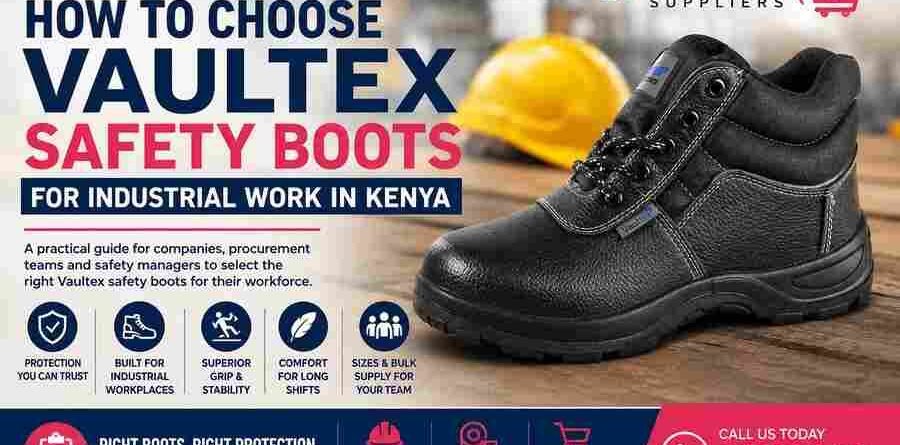
How to Choose Vaultex Safety Boots for Industrial Work in Kenya
Choosing the right Vaultex safety boots in Kenya starts with understanding workplace hazards, protective features and employee comfort.
Safety footwear should not be selected by price or appearance alone. Construction workers, factory employees, engineers and warehouse teams may face different risks.
In this guide, we explain how to choose suitable Vaultex safety boots, what the manufacturer’s specifications mean and what to check before purchasing.
At Bansi Suppliers, our featured Vaultex Safety Boots in Kenya are available at KSh 2,500 + VAT per pair.
1. Identify Your Workplace Hazards
Before buying industrial safety boots, identify the hazards employees face during their daily work.
Common hazards include:
- Falling tools and materials
- Heavy equipment and machinery
- Sharp objects on the ground
- Slippery or contaminated floors
- Oil and fuel exposure
- Uneven working surfaces
- Long periods of standing or walking
For example, a construction worker may need protection against falling materials and sharp objects underfoot.
A factory employee may work around machinery, while a warehouse worker may spend much of the day walking and handling stock.
The correct safety boot is one whose documented protective features match the actual workplace risks.
A workplace risk assessment should guide the selection.
2. Understand the Protective Features of Vaultex Safety Boots
The Vaultex industrial safety boot supplied by Bansi Suppliers combines protective components with materials intended for workplace footwear.
Its manufacturer’s technical datasheet identifies the following features.
Steel Toe Protection — 200 Joules
The boot includes a steel toe cap rated for 200 joules of impact protection.
The manufacturer also specifies compression protection of 15,000 newtons.
Toe protection is particularly important where employees work around heavy materials, machinery or equipment that may cause impact or compression injuries.
Penetration-Resistant Steel Midsole
The boot includes a protective steel midsole.
According to the manufacturer, the midsole provides penetration resistance exceeding 1,100 N.
This feature may be relevant for construction, engineering and maintenance work where nails, sharp metal or other objects could be present underfoot.
Buffalo Leather Upper
The upper is made from buffalo leather.
Leather construction provides a durable material option for suitable industrial working environments.
However, a leather upper should not automatically be considered waterproof or suitable for chemical exposure.
Dual-Density PU/PU Outsole
The boot uses a dual-density polyurethane outsole.
Outsole construction matters because workers may spend long periods walking or standing.
The manufacturer also describes slip resistance and resistance to oil and fuel. Check whether these properties meet your specific workplace requirements.
Shock-Absorbing Heel
The technical datasheet specifies heel energy absorption exceeding 20 joules.
This is one of the factors to consider when evaluating footwear for employees who stand or walk throughout their shifts.
Antistatic Properties
The manufacturer describes the boot as antistatic.
Antistatic footwear is not the same as electrically insulating footwear.
Do not use these boots as protection against electrical shock unless the necessary documentation specifically supports that application.
View Vaultex Safety Boots and Product Specifications
3. Check the Safety Standards and Workplace Conditions
When purchasing safety footwear for a company, confirm the required technical standard before selecting a product.
The supplied Vaultex datasheet references EN ISO 20345:2011 and also lists ASTM F2413-18, AS/NZS 2210.3 and SS105.
These references should not be treated as independent proof that every certification or classification has been verified.
Where your tender or workplace policy specifies a standard, request the relevant documentation for the exact footwear supplied.
Is the Vaultex Safety Boot Waterproof?
The supplied technical sheet does not establish a specific waterproof rating.
Do not assume that leather safety footwear provides waterproof protection.
Is It Suitable for Chemical Handling?
The manufacturer mentions resistance to selected substances, including acids and alkalis.
However, this does not establish suitability for every chemical, concentration or exposure duration.
For chemical-handling work, select footwear using the chemical’s identity, concentration, exposure conditions and documented manufacturer compatibility.
What About Slippery Floors?
The manufacturer describes slip-resistant properties, but the supplied sheet does not establish a specific tested slip classification.
Consider the actual floor surface, contaminants, cleaning procedures and workplace risk assessment.
No safety boot should be assumed to prevent slipping in every situation.
4. Match Vaultex Safety Boots to the Employee’s Job
Vaultex industrial safety boots may be considered for different industries when their protective features match the job requirements.
Construction Workers
Construction sites may expose workers to falling materials, tools, uneven ground and sharp objects.
The featured Vaultex boot’s steel toe cap and protective midsole are relevant features when assessing these risks.
For broader site requirements, visit Construction PPE Kenya.
Manufacturing and Factory Workers
Factory employees may require protective footwear when working around machinery, materials and production equipment.
Different departments may have different footwear needs.
Explore our Manufacturing PPE Supplier Kenya solutions.
Warehouse and Logistics Workers
Warehouse teams often spend long periods walking, loading, packing or moving stock.
Important considerations include fit, toe protection, outsole suitability and walking comfort.
See our Warehouse & Logistics PPE solutions.
Engineers and Maintenance Technicians
Engineers, mechanics and maintenance personnel may work around tools, machinery, sharp objects, oils and industrial equipment.
Footwear selection should account for the hazards of each task, rather than relying on the employee’s job title alone.
The same Vaultex product can serve different industries where its documented specifications meet the relevant safety requirements.
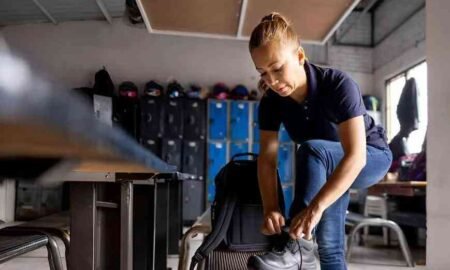
5. Select the Correct Safety Boot Size and Fit
Even a well-specified safety boot may be unsuitable if it does not fit correctly.
Before purchasing, employees should confirm their footwear sizes.
When checking fit, consider:
- Enough room for the toes
- Secure heel positioning
- Comfortable fastening
- Suitable socks for work
- Walking and standing comfort
- No excessive pressure or rubbing
For company orders, collect the actual sizes required by employees.
A clear size schedule should include the number of pairs needed for each size.
This helps reduce ordering errors and makes repeat procurement easier.
For larger teams, you can upload an employee-size schedule or procurement list.
6. Compare Vaultex Safety Boots Prices and Specifications
The listed price of the featured Vaultex industrial safety boot at Bansi Suppliers is:
KSh 2,500 + VAT per pair.
Before comparing prices with other safety footwear, confirm that the products meet the same workplace requirements.
Consider the toe protection, midsole, outsole construction, materials, fit and relevant documentation.
A lower price does not necessarily represent better value if the footwear lacks a required protective feature.
Similarly, a higher price should not be taken as proof of better safety performance.
For wider footwear comparisons, visit our Safety Boots Price in Kenya page.
View Vaultex Safety Boots – KSh 2,500 + VAT
7. Prepare for Bulk Safety Boot Procurement
Companies purchasing safety boots for multiple employees should prepare their requirements before requesting a quotation.
Include:
- Exact safety boot or approved specification
- Required sizes
- Quantity per size
- Total quantity
- Department or project
- Delivery location
- Required delivery date
For formal procurement, you may submit an RFQ, BOQ, purchase requisition or Excel schedule.
Bansi Suppliers supports footwear purchasing for employee onboarding, construction projects, factories, institutions and recurring workplace PPE requirements.
Visit Vaultex Safety Boots Kenya – Corporate Supply for company orders.
For larger multi-brand requirements, explore Wholesale Safety Boots Kenya.
Vaultex Safety Boots Buying Checklist
Before approving the purchase, confirm that:
- Workplace hazards have been identified.
- The steel toe protection meets the required specification.
- Underfoot penetration protection has been assessed.
- Outsole properties suit the working conditions.
- Any water, chemical or electrical requirements have been verified separately.
- The required standard and documentation have been checked.
- Employees have confirmed their sizes.
- The correct quantity is available for the order.
- Pricing and applicable VAT are understood.
Completing these checks helps companies make more informed footwear purchasing decisions.
Frequently Asked Questions
How much are Vaultex safety boots in Kenya?
The featured Vaultex industrial safety boots are listed by Bansi Suppliers at KSh 2,500 + VAT per pair.
Do Vaultex safety boots have steel toe protection?
The model covered in this guide has a manufacturer-specified steel toe cap rated at 200 joules.
Do these Vaultex boots have a protective steel midsole?
Yes. The manufacturer specifies a penetration-resistant steel midsole with resistance exceeding 1,100 N.
Are Vaultex safety boots waterproof?
The supplied technical sheet does not establish waterproof performance. Additional manufacturer documentation would be needed.
Can Vaultex safety boots be used for electrical work?
The featured model is described as antistatic, not electrically insulating. Do not assume it provides protection against electrical shock.
Are Vaultex safety boots suitable for construction?
They may be suitable where their documented protective features meet the hazards and safety requirements of the construction site.
Can companies order Vaultex safety boots in bulk?
Yes. Companies can submit required quantities, employee sizes and delivery details for a formal quotation.
Buy Vaultex Safety Boots in Kenya
Choosing suitable industrial safety footwear starts with the workplace hazards, required protection and correct employee fit.
Bansi Suppliers provides the featured Vaultex industrial safety boot at KSh 2,500 + VAT per pair.
View and Buy Vaultex Safety Boots
For corporate purchases, Request a Quotation or Upload Your Procurement List.
Call/WhatsApp: 0722 353 974
Bansi Suppliers — Source. Supply. Succeed.