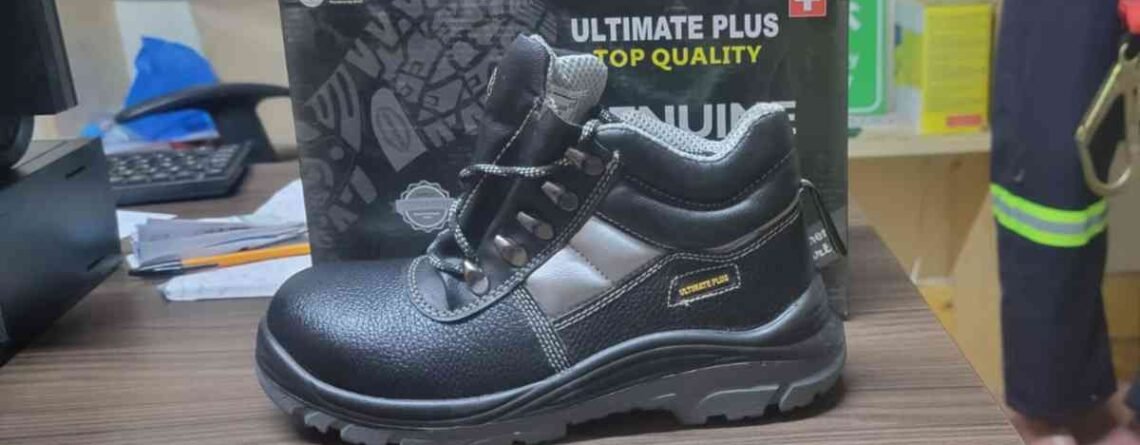
Ultimate Plus Safety Boots Review Kenya – Features, Pros & Limitations
Are Ultimate Plus safety boots a suitable choice for industrial workplaces in Kenya?
For construction companies, manufacturers, engineering firms and warehouse operators, protective footwear must meet the hazards employees face.
In this Ultimate Plus safety boots review, we examine the manufacturer’s technical specifications, protective features and limitations.
We also explain which workplace applications may be appropriate and what procurement teams should verify before placing an order.
This is a technical specification-based review, not an independent wear test.
For the actual footwear model, view Ultimate Plus Industrial Steel Toe Safety Boots.
Ultimate Plus Safety Boots – Technical Specifications
The manufacturer-supplied datasheet identifies the following features for the reviewed model.
| Feature | Manufacturer-stated specification |
|---|---|
| Brand | Ultimate Plus |
| Upper material | Buffalo leather |
| Toe protection | Steel toe cap |
| Toe impact protection | 200 joules |
| Toe compression protection | 11,000 newtons |
| Protective midsole | Steel |
| Midsole penetration resistance | Above 1,000 newtons |
| Outsole | Dual-density PU/PU |
| Insole | EVA |
| Heel energy absorption | Above 20 joules |
| Antistatic properties | Stated by manufacturer |
| Standard referenced | EN ISO 20345:2011 |
The manufacturer also describes oil and fuel resistance, alongside other outsole performance characteristics. However, detailed test classifications and chemical compatibility information should be verified where required.
These specifications apply to the featured Ultimate Plus model. They should not automatically be attributed to every boot sold under a similar name.
1. Steel Toe Protection – A Key Strength
The Ultimate Plus boot includes a steel toe cap with manufacturer-stated impact protection of 200 joules.
The datasheet also identifies compression protection of 11,000 newtons.
This is relevant for jobs involving potential impact or compression hazards from equipment, tools and materials.
Such hazards may occur in construction, warehouses, engineering workshops and manufacturing plants.
Assessment: Steel toe protection is one of the boot’s main documented strengths. Buyers should still confirm that the exact model meets their workplace specifications.
2. Steel Midsole – Underfoot Protection
Another useful feature is the protective steel midsole.
The manufacturer states penetration resistance exceeding 1,000 newtons.
This feature is relevant when evaluating protection against sharp objects underfoot.
However, toe protection and penetration protection serve different purposes. Both should be assessed separately.
Assessment: The protective midsole strengthens the boot’s suitability for consideration in industrial environments with identified penetration hazards.
3. Buffalo Leather Upper – Construction and Maintenance
The reviewed Ultimate Plus boot uses a buffalo leather upper.
Leather is a commonly used material in industrial safety footwear.
For businesses, upper construction matters because footwear is exposed to regular movement, contact with materials and general workplace wear.
However, the leather upper alone does not prove that the boot is waterproof, heat-resistant or chemically protective.
Assessment: Buffalo leather is a practical construction material, but durability over time cannot be established without appropriate testing or real-world performance data.
4. Dual-Density PU/PU Sole – Workplace Use
Ultimate Plus safety boots feature a dual-density polyurethane outsole.
This design combines polyurethane layers within the sole construction.
The manufacturer also identifies resistance to oil and fuel and describes slip-related performance.
For procurement teams, these features deserve attention in workplaces with hard floors, movement-intensive tasks or possible surface contamination.
However, the supplied technical information does not establish a specific slip-test classification.
Assessment: The sole design is a useful feature to evaluate. Employers should verify the required slip-resistance performance for their working conditions.
5. EVA Insole and Heel Energy Absorption
The manufacturer identifies an EVA insole with antibacterial and antifungal properties.
It also states heel energy absorption above 20 joules.
These are relevant construction features, especially when selecting footwear for workers who spend substantial time standing or walking.
However, comfort depends on several factors, including size, fit, employee duties and the working environment.
Assessment: The insole and heel design offer useful documented features, but all-day comfort cannot be guaranteed for every wearer.
6. Antistatic Properties
Ultimate Plus boots are described as having antistatic characteristics.
These properties may be relevant in workplaces where static electricity is a consideration.
However, antistatic performance should not be confused with electrical insulation.
The reviewed Ultimate Plus boot should not be presented as protection against electric shock without appropriate supporting documentation.
For electrical tasks, employers must select footwear based on a specific electrical risk assessment.
7. Important Limitations Buyers Should Know
A balanced Ultimate Plus safety boots review should explain what the available datasheet does not establish.
Waterproof Performance
The supplied manufacturer information does not establish a waterproof rating.
Do not assume the boots will keep feet dry during prolonged wet conditions.
Chemical Resistance
The datasheet mentions resistance to certain substances, but does not include a detailed chemical-compatibility table.
This means suitability for specific chemicals, concentrations and exposure periods cannot be confirmed from the supplied information alone.
Electrical Insulation
The boots are described as antistatic, not electrically insulating.
Additional footwear specifications are necessary where electrical shock hazards exist.
Certification and Safety Classes
The manufacturer references EN ISO 20345:2011.
However, the supplied sheet does not establish an exact S1, S1P, S2 or S3 classification.
Procurement teams should request the appropriate supporting documentation if these classifications are required.
Ultimate Plus Safety Boots: Pros and Limitations
| Documented strengths | Limitations requiring verification |
|---|---|
| 200J steel toe impact protection | No confirmed waterproof rating |
| Steel protective midsole | No detailed chemical-compatibility data |
| Buffalo leather upper | Long-term durability not independently tested |
| Dual-density PU/PU outsole | Specific slip-test classification not confirmed |
| EVA insole and heel energy absorption | Comfort depends on individual fit |
| Manufacturer-stated antistatic properties | Not established as electrically insulating |
The boot offers several useful industrial footwear features.
However, these characteristics should be assessed against the employer’s actual workplace requirements.
Which Industries Should Consider Ultimate Plus Safety Boots?
Construction Companies
Construction projects may expose workers to falling materials, sharp objects and uneven working surfaces.
The boot’s steel toe and protective midsole are relevant when assessing these hazards.
Explore our Construction PPE Kenya solutions.
Manufacturing and Engineering
Factories and engineering facilities may require protective footwear for machine operators, maintenance workers and technicians.
The suitability of the boot depends on the specific department and job hazards.
Visit Manufacturing PPE Supplier Kenya.
Warehousing and Logistics
Warehouse teams may work around stored goods, loading equipment, pallets and material-handling machinery.
The Ultimate Plus boot may be considered where its documented protection meets these workplace risks.
Explore Warehouse and Logistics PPE.
Are Ultimate Plus Safety Boots Worth Considering for Corporate Procurement?
Based on the manufacturer’s specifications, Ultimate Plus safety boots are worth evaluating for industrial workplaces requiring steel toe protection, a protective midsole and a dual-density outsole.
Their documented construction makes them a potential option for certain construction, manufacturing, engineering and warehousing tasks.
However, their suitability depends on the hazard assessment, required technical standards and employee fit.
For companies purchasing multiple pairs, the decision should also consider:
- Required quantities
- Employee sizes
- Technical approval
- Current quotation price
- Replacement requirements
- Delivery arrangements
A specification-based decision is more useful than selecting footwear based only on promotional claims.
For company supply requirements, visit Ultimate Plus Safety Boots Kenya – Corporate Supply.
Ultimate Plus Safety Boots – Frequently Asked Questions
Are Ultimate Plus safety boots suitable for construction?
They may be suitable where their documented protective features meet the hazards and safety requirements of the construction site.
Do Ultimate Plus safety boots have a steel toe?
Yes. The featured model has a manufacturer-specified steel toe cap rated for 200J impact protection.
Do Ultimate Plus safety boots have a steel midsole?
Yes. The manufacturer identifies a protective steel midsole with penetration resistance above 1,000N.
Are Ultimate Plus safety boots waterproof?
The supplied technical datasheet does not confirm a waterproof rating.
Are Ultimate Plus safety boots chemical resistant?
The manufacturer mentions resistance to selected substances. However, suitability for specific chemical exposure requires appropriate compatibility information.
Are Ultimate Plus boots comfortable for long shifts?
They include an EVA insole and heel energy absorption features. However, comfort varies with fit, employee duties and working conditions.
Can companies purchase Ultimate Plus safety boots in bulk?
Yes. Bansi Suppliers supports company procurement enquiries based on quantities, employee sizes, specifications and delivery requirements.
Final Verdict: Ultimate Plus Safety Boots Review Kenya
Ultimate Plus industrial safety boots have several manufacturer-documented protective features.
The strongest points include the 200J steel toe, protective steel midsole, buffalo leather upper and dual-density PU/PU outsole.
These features make the boot worth assessing for suitable industrial applications.
Nevertheless, companies should verify any additional waterproofing, electrical, chemical or certification requirements before approving the model.
For technical details and purchasing information, visit our Ultimate Plus Industrial Steel Toe Safety Boots product page.
For workforce orders, request a corporate quotation or upload your procurement list.
Call/WhatsApp: 0722 353 974
Bansi Suppliers — Source. Supply. Succeed.