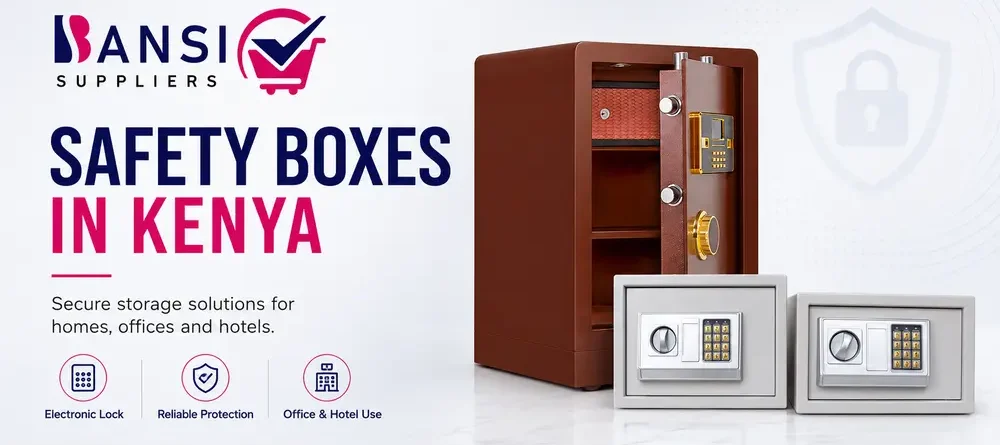
When choosing secure storage, many buyers compare a fireproof safe box vs normal safe box and assume the main difference is simply the material used.
The difference is more important than that.
A general safe box may provide controlled storage for cash, documents, keys and valuables. However, that does not automatically mean it has documented fire resistance.
A fire-resistant safe should have manufacturer information or recognised test documentation supporting the fire protection being claimed.
Remember:
- Steel construction does not automatically mean fireproof
- A digital lock does not automatically mean fireproof
- A heavy safe does not automatically mean fireproof
If fire protection is important, check the specification of the exact safe before buying.
You can also browse Safe Boxes in Kenya to compare available options.
Fireproof Safe vs Normal Safe at a Glance
| Feature | Fire-Resistant Safe | Normal Safe Box |
|---|---|---|
| Controlled storage | Yes, depending on model | Yes, depending on model |
| Fire protection | Should have documented specification where claimed | Should not be assumed |
| Main purpose | Storage requiring specified fire protection | General controlled storage |
| Lock type | Key, digital, biometric or other depending on model | Key, digital, biometric or other depending on model |
| Fire rating | Important to verify | May not have one |
| Rated duration | May be stated in documentation | Usually not applicable unless specifically rated |
| Burglary resistance | Separate specification | Separate specification |
| Price | Depends on rating, size and construction | Varies widely |
The exact product specification matters more than the marketing name.
What Is a Fireproof Safe Box?
“Fireproof safe” is a common search term, but fire-resistant safe is generally a more accurate description.
No safe should be assumed to provide unlimited protection under every possible fire condition.
A properly specified fire-resistant safe is designed for defined fire-performance conditions.
When comparing one, check:
- Manufacturer fire rating
- Applicable test standard
- Rated duration
- Test conditions where stated
- Intended contents
- Exact model covered by the documentation
For more detailed guidance, see our Fireproof Safe Box in Kenya page.
What Is a Normal Safe Box?
A general-purpose safe is primarily intended to provide controlled physical storage.
Depending on the product, it may be used for:
- Cash
- Jewellery
- Keys
- Passports
- Certificates
- Cheque books
- Company stamps
- Contracts
- Personal documents
- Business records
A normal safe may use:
- Physical key
- Digital keypad
- Combination lock
- Biometric access
- Multiple access methods
None of these locking systems alone proves that the safe has documented fire resistance.
Does a Steel Safe Protect Documents From Fire?
Not necessarily.
Steel is commonly used in safe construction, but steel alone does not establish how the contents inside will perform during a fire.
Fire resistance can depend on factors such as:
- Safe construction
- Insulating materials
- Door design
- Seals
- Internal protection system
- Tested duration
- Applicable standard
Do not assume that a product is fire resistant simply because it is described as a steel safe.
What Does a Fire Rating Mean?
A fire rating describes performance under specified test conditions.
The exact meaning depends on the standard and rating applied.
If a manufacturer or supplier claims that a safe has a fire rating, ask:
- What test standard applies?
- What protection duration is stated?
- What type of contents does the rating cover?
- Does the rating apply to this exact model?
- Is supporting documentation available?
This is more useful than relying only on terms such as fireproof, heat resistant or heavy duty.
Why Fire-Resistance Duration Matters
Fire-resistant products may be tested for a defined duration.
A rating covering one period should not automatically be treated as equivalent to a longer rating.
The appropriate requirement may depend on:
- Building environment
- Type of records
- Organisational risk assessment
- Procurement specification
- Tender requirements
If your RFQ specifies a particular fire rating, select against that requirement rather than substituting a generic “fireproof safe.”
Paper Documents and Digital Media Are Different
This is an important consideration when selecting fire-resistant storage.
Paper Documents
Examples include:
- Title deeds
- Contracts
- Certificates
- Licences
- Insurance records
- Company registration documents
If protecting paper is the main requirement, check whether the stated fire rating applies to paper records.
Digital Media
Examples include:
- USB drives
- External drives
- Memory cards
- Other electronic storage media
Electronic media may have different temperature and environmental tolerances from paper.
Do not assume that a safe intended to protect paper documents is automatically suitable for electronic media.
Verify the manufacturer’s intended application.
Which Safe Is Better for Important Documents?
The answer depends on what protection you require.
If your main goal is controlling unauthorised access, a suitable general safe may meet your requirement.
If you also require documented fire protection, consider a safe with a relevant fire-resistance specification.
Also check:
- Internal dimensions
- Whether documents must remain flat
- Number of files or records
- Access frequency
- Lock type
- Installation
- Required security specification
Do not choose based only on the word “fireproof.”
Which Safe Is Better for Office Documents?
Not every office record needs the same level of protection.
Routine Records
Ordinary filing cabinets may be more appropriate for routine documents and day-to-day records.
Restricted Documents
A general safe may be suitable for:
- Contracts
- Company stamps
- Cheque books
- Restricted keys
- Selected confidential records
Critical Records
Consider a properly specified fire-resistant safe where documented fire protection is required for critical records.
For workplace-specific guidance, see Office Safe Box in Kenya.
Which Safe Is Better for Petty Cash?
Fire resistance is only one consideration when selecting a petty-cash safe.
A business should also evaluate:
- Amount of cash normally stored
- Number of authorised users
- Frequency of access
- Locking system
- Installation
- Internal procedures
- Required physical-security specification
A general safe may suit many petty-cash applications.
Where important documents are stored together with cash and fire protection is required, a suitable fire-resistant model may be more appropriate.
Does a Fire-Resistant Safe Prevent Theft?
Not automatically.
Fire resistance and burglary resistance are different characteristics.
A fire rating should not be interpreted as proof that the safe provides a particular level of burglary resistance.
If physical security against theft is important, assess:
- Overall construction
- Locking mechanism
- Door design
- Anchoring
- Installation
- Manufacturer security specification
- Documented security rating where required
If you need both fire resistance and burglary resistance, verify both separately.
Does a Heavy Safe Mean Better Security?
Not necessarily.
Weight can affect handling and may reflect differences in construction. However, weight alone is not a security rating.
Compare:
- Construction
- Door design
- Lock
- Installation
- Anchoring provisions
- Documented security information
A heavier safe is not automatically more secure, and a lighter safe is not automatically unsuitable.
Can a Digital Safe Also Be Fire Resistant?
Yes, depending on the model.
However:
Digital describes the access method.
Fire resistant describes a different product characteristic.
A digital keypad does not prove that a safe has a fire rating.
If you specifically want electronic access, see our Digital Safe Box in Kenya guide and then verify the fire-resistance specification separately.
Can a Key-Lock Safe Be Fire Resistant?
Yes, depending on the product.
A mechanical key lock neither proves nor disproves fire resistance.
Always assess the complete safe specification.
If you are deciding between electronic and mechanical access, read our Digital Safe Box vs Key Lock Safe Box comparison.
Fireproof Safe vs Normal Safe for Home Use
A normal safe may suit a home where the main requirement is controlled storage for:
- Cash
- Jewellery
- Passports
- Documents
- Keys
- Other valuables
A fire-resistant safe may be considered where documented fire protection is required for important records such as:
- Title deeds
- Certificates
- Insurance documents
- Legal records
- Important family documents
The appropriate choice still depends on the exact protection specification and intended contents.
Fireproof Safe vs Normal Safe for Business Use
Businesses should first divide their storage requirements into two broad groups.
General Controlled Storage
This may include:
- Keys
- Company stamps
- Petty cash
- Routine restricted documents
Critical Document Storage
This may include records such as:
- Legal documents
- Company registration records
- Critical contracts
- Essential certificates
- Important continuity documents
This approach can help businesses avoid over-specifying ordinary storage while also preventing critical records from being under-protected.
Fireproof Safe vs Normal Safe Prices
There is no fixed price difference between a fire-resistant safe and a normal safe.
Safe prices can vary according to:
- Size
- Internal capacity
- Construction
- Weight
- Lock type
- Fire specification
- Security specification
- Shelves or compartments
- Manufacturer
- Model
- Quantity required
A smaller fire-resistant safe can potentially cost less than a larger premium general-purpose safe.
Compare equivalent products rather than judging only by the labels.
For price-focused information, visit Safe Box Price in Kenya.
When Is a Normal Safe Enough?
A general safe may be suitable where your main objective is controlled storage and you do not require documented fire resistance.
Possible uses include:
- Petty cash
- Keys
- Jewellery
- Cheque books
- Company stamps
- Passports
- General valuables
The product should still meet your required size, access and physical-security specifications.
When Should You Consider a Fire-Resistant Safe?
Consider documented fire resistance when:
- Important documents would be difficult to replace
- Your organisation’s risk assessment requires it
- A procurement specification requires a fire rating
- You are protecting critical records
- Organisational or insurance requirements specify it
- Business-continuity planning requires protected physical records
The decision should come from the requirement, not simply because the word “fireproof” sounds safer.
Common Mistakes When Comparing Fireproof and Normal Safes
Avoid these common mistakes:
- Assuming every steel safe is fireproof
- Assuming all fire-resistant safes have the same rating
- Ignoring rated duration
- Ignoring the applicable test standard
- Assuming fire resistance also means burglary resistance
- Assuming heavier always means more secure
- Choosing by exterior dimensions only
- Ignoring usable internal space
- Assuming a digital lock means fire resistance
- Choosing only according to price
- Storing digital media without checking suitability
- Failing to verify which exact model is covered by the stated rating
Fireproof vs Normal Safe Buying Checklist
Before choosing, answer these questions.
Contents
- What will be stored?
- Are the contents paper or electronic?
- How difficult would they be to replace?
Fire Protection
- Do I actually need documented fire resistance?
- What rating is required?
- What standard applies?
- What duration is required?
- Does the documentation cover this exact model?
Physical Security
- Do I also require burglary resistance?
- Is a particular security rating required?
- Can the safe be anchored?
Access
- Do I need key, digital or biometric access?
- Who requires access?
- How often will it be opened?
- What is the backup-access method?
Capacity
- What internal dimensions are required?
- Will storage needs increase?
Installation
- Where will the safe be positioned?
- Can the delivery route accommodate its size and weight?
- Is wall or floor mounting required?
Fireproof Safe or Normal Safe: Which Should You Choose?
The decision should not be:
Fireproof = good
Normal = bad
Instead, match the safe to the requirement.
Choose a general safe box when your priority is controlled storage and there is no documented fire-resistance requirement.
Consider a fire-resistant safe when protecting important records against specified fire exposure is part of the requirement.
If both fire resistance and burglary resistance are necessary, verify both independently.
Compare Safe Boxes in Kenya
After defining your requirement, browse our Safe Boxes in Kenya category.
For fire-specific selection, visit Fireproof Safe Box in Kenya.
For workplace applications, see Office Safe Box in Kenya.
For electronic-access requirements, visit Digital Safe Box in Kenya.
For broader product-selection guidance, read How to Choose the Best Safe Box in Kenya.
For pricing, visit Safe Box Price in Kenya.
For corporate, institutional or project requirements, request a quotation.
If you already have an RFQ, BOQ or procurement schedule specifying the required safe, upload your procurement list.
Frequently Asked Questions
What is the difference between a fireproof safe and a normal safe?
A general safe provides controlled storage according to its specification. A fire-resistant safe additionally has documented fire-performance information where such protection is claimed.
Is every steel safe fireproof?
No. Steel construction alone does not establish fire resistance.
Is a fireproof safe completely fireproof?
No safe should be assumed to provide unlimited protection under every possible fire condition. Check the stated rating, test information and protection duration.
Does a fire-resistant safe protect against burglars?
Not automatically. Fire resistance and burglary resistance are separate characteristics.
Can a digital safe be fire resistant?
Yes, depending on the model. Digital refers to the access system, while fire resistance is a separate specification.
Which safe is suitable for title deeds?
Choose a safe with adequate internal dimensions and suitable access control. If documented fire protection is also required, verify an appropriate fire-resistance specification for the exact model.
Which safe is suitable for office cash?
The appropriate model depends on cash volume, frequency of access, authorised users, installation and required physical-security features. Fire resistance may not be the main requirement for cash storage alone.
Is a normal safe suitable for home use?
It can be, depending on your storage and security requirements. If documented fire protection for important records is required, consider a properly specified fire-resistant safe.
Are fire-resistant safes always more expensive?
Not necessarily. Price depends on the complete specification. A larger or more heavily specified normal safe may cost more than a smaller fire-resistant model.
Does safe weight prove security?
No. Weight alone is not a security rating.
Can I store USB drives in a fire-resistant document safe?
Do not assume a safe intended for paper documents is suitable for electronic media. Check the manufacturer’s intended contents and specification.
Where can I compare safe box prices in Kenya?
See our Safe Box Price in Kenya guide for price-focused information.
Where can I buy safe boxes in Kenya?
Browse the Bansi Suppliers Safe Box category or request a quotation for a specific technical requirement.
Bansi Suppliers — Source. Supply. Succeed.