The best safe box for office documents and petty cash is not simply the heaviest, most expensive or most advanced model.
The right office safe should match what your organisation needs to store, how frequently authorised employees need access, the internal capacity required and the locking system that fits your internal procedures.
Businesses may use an office safe for items such as:
- Petty cash
- Company stamps
- Cheque books
- Contracts
- Business licences
- Important certificates
- Restricted keys
- Selected finance records
- Confidential documents
- Cash receipts
- Other controlled-access office items
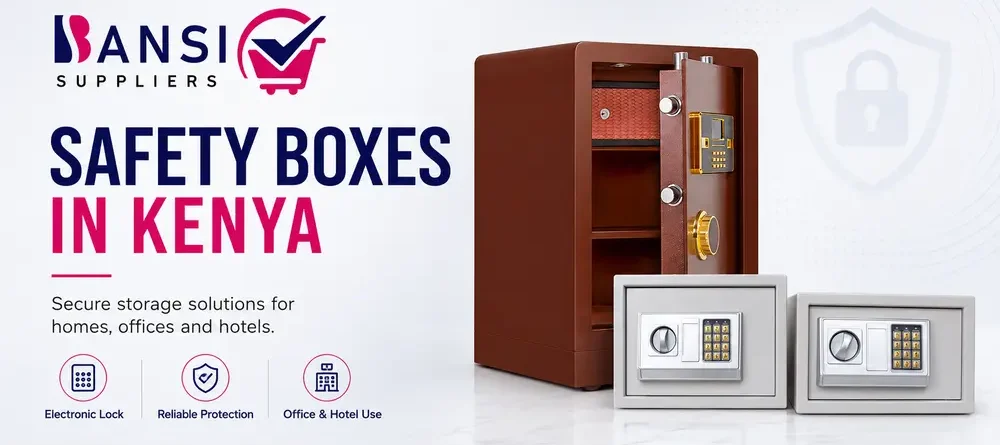
For currently available options, browse our Safe Boxes in Kenya category.
For broader workplace requirements, see our Office Safe Box in Kenya guide.
Why Offices Need Controlled Storage
An office normally contains both routine documents and items that require restricted access.
Routine paperwork may be stored in filing cabinets, drawers or general office storage.
However, items such as petty cash, cheque books, company stamps, restricted keys, important contracts and confidential records may require tighter control.
A safe can provide one defined location for selected sensitive items.
However, the safe should form part of a broader internal-control procedure rather than being treated as the entire security system.
Best Safe Box for Petty Cash
A petty-cash safe should be chosen according to how the organisation actually handles cash.
Before selecting a model, ask:
- How much petty cash is normally held?
- How often is money added or removed?
- How many employees need access?
- Who is responsible for reconciliation?
- Will the safe be opened several times per day?
- Where will the safe be installed?
- Is key or electronic access preferred?
A small office holding a limited petty-cash float may have very different requirements from a finance department dealing with larger daily cash movements.
A Safe Does Not Replace Petty-Cash Controls
A safe can restrict physical access, but it does not replace proper cash-management procedures.
Businesses should still define:
- Who may access petty cash
- Who approves withdrawals
- Who maintains the records
- How receipts are handled
- How balances are reconciled
- What happens when the responsible employee is absent
- How access changes when staff roles change
The best arrangement combines appropriate secure storage with clear internal procedures.
Best Safe Box for Office Documents
Office documents can require more space than cash, keys or stamps.
Consider the physical size and type of documents you need to store.
These may include:
- Company registration documents
- Contracts
- Business licences
- Certificates
- Cheque books
- Company stamps
- Confidential records
- Selected finance documents
Important records should fit comfortably inside without unnecessary folding or damage.
Check Internal Dimensions Before Buying
One of the most important checks is the safe’s internal dimensions.
Do not choose based only on the external appearance.
Check:
- Internal width
- Internal height
- Internal depth
- Number of shelves
- Shelf arrangement
- Internal compartments
- Door opening
If you intend to store A4 files, document folders or envelopes, measure them first.
A safe can appear large on the outside while providing less usable internal space because of its door and wall construction.
Should Office Documents Be Stored Flat?
That depends on the document.
Certificates, contracts and legal papers may be easier to organise when kept flat.
If this matters, compare the safe’s internal dimensions with:
- A4 documents
- Folders
- Document envelopes
- Files
- Certificate holders
This simple measurement can prevent buying a safe that is technically large but impractical for your actual paperwork.
Digital Safe vs Key Lock for an Office
Both locking systems can work in an office.
The appropriate choice depends on how access will be managed.
Digital Safe Box
A digital safe may be practical where:
- The safe is opened frequently
- Several authorised employees require access
- Management wants to change the access code
- Physical key handling would be inconvenient
Digital safes may use a keypad, PIN or another electronic system depending on the product.
Before buying, confirm:
- Battery requirements
- Code-change procedure
- Backup opening method
- Low-battery procedure
- Supported users where applicable
For more information, see our Digital Safe Box in Kenya guide.
Key-Lock Safe
A key-operated safe may suit an office where:
- One designated person controls access
- The safe is opened less frequently
- Management prefers mechanical operation
- Key custody can be tightly controlled
The organisation should still manage:
- Primary key
- Spare keys
- Authorised key holders
- Lost-key procedures
- Key handover when employees change roles
For a direct comparison, read Digital Safe Box vs Key Lock Safe Box.
Which Lock Type Is Better for Petty Cash?
Neither is automatically better.
A digital lock may be convenient where authorised staff need frequent access.
A key lock may work well where one accounts officer, cashier or manager is responsible for the safe.
Choose according to your internal process rather than assuming one access technology is universally more secure.
What About Biometric Safes?
Some electronic safes use fingerprint access.
Where biometric access is being considered, check:
- Number of fingerprints supported
- Backup access method
- Battery requirements
- Reset procedure
- Whether PIN access is also available
- Exact model specification
Do not assume every digital safe includes biometric access.
Where Should an Office Safe Be Installed?
Choose the location before purchasing.
Consider:
- Available floor or furniture space
- Safe dimensions
- Safe weight
- Door clearance
- Employee access
- Visitor visibility
- Delivery route
- Stairs or lifts
- Mounting requirements
A safe should not be placed somewhere simply because space is available.
The final position should support both controlled access and practical daily use.
Should an Office Safe Be Bolted Down?
Some safe models include provisions for wall or floor anchoring.
Where mounting is required, confirm:
- Whether the exact model supports anchoring
- Manufacturer installation guidance
- Suitable wall or floor construction
- Recommended fixing method
Do not assume that every safe should be drilled or modified in the same way.
Does Safe Weight Matter?
Weight can matter for delivery and installation.
However, a heavier safe is not automatically more secure.
Overall security can also depend on:
- Construction
- Door design
- Locking mechanism
- Installation
- Anchoring
- Manufacturer specification
- Documented security rating where applicable
Use weight as one comparison factor rather than treating it as a complete measure of security.
Should Office Documents Be Kept in a Fire-Resistant Safe?
Only where documented fire resistance is part of your requirement.
A normal steel safe should not automatically be treated as fireproof.
If important documents require fire-resistant storage, check the exact product for:
- Manufacturer fire rating
- Applicable test standard
- Protection duration
- Intended contents
- Exact model covered by the stated rating
For more detail, read Fireproof Safe Box in Kenya.
You can also compare Fireproof Safe Box vs Normal Safe Box.
Which Office Records May Need Fire-Resistant Storage?
Depending on the organisation’s risk assessment and records policy, this may include:
- Critical contracts
- Company registration documents
- Important certificates
- Legal documents
- Business-continuity records
- Selected originals that are difficult to replace
Not every office file needs a fire-rated safe.
Routine paperwork may be more appropriately stored in filing cabinets.
Office Safe vs Filing Cabinet
This distinction is important.
Use an Office Safe for Selected Items Such As:
- Petty cash
- Cheque books
- Company stamps
- Restricted keys
- Important contracts
- Confidential documents
- Selected valuables
Use a Filing Cabinet for:
- Routine files
- General administrative records
- Stationery
- Everyday documents
- General office storage
For standard workplace filing, browse Office Cabinets in Kenya.
Safe Box for Accounts and Finance Departments
Accounts and finance teams may require controlled storage for:
- Petty cash
- Cheque books
- Cash receipts
- Selected payment documents
- Restricted finance records
- Company stamps
- Keys
The department should define:
- Safe custodian
- Authorised users
- Access procedure
- Cash reconciliation process
- Backup access
- Staff handover procedure
This helps make the safe part of a proper finance-control system.
Safe Box for Administration Departments
Administration teams may need secure storage for:
- Company registration documents
- Licences
- Contracts
- Certificates
- Official stamps
- Important keys
- Selected organisational records
Capacity may be especially important because documents and files can occupy considerably more space than petty cash or keys.
Small vs Larger Office Safe
Small Office Safe
May be suitable for:
- Petty cash
- Company stamps
- Cheque books
- Keys
- Limited documents
Medium Office Safe
May suit:
- Cash and documents
- Several folders
- Business records
- Finance or administrative use
Larger Office Safe
May be required for:
- Multiple files
- Greater document volumes
- Several departments
- Larger organisations
- Institutional requirements
Choose according to usable internal capacity, not simply the outside size.
Office Safe Box Prices in Kenya
Office safe prices can vary according to:
- Size
- Internal capacity
- Locking system
- Construction
- Product weight
- Internal compartments
- Electronic features
- Documented protection features
- Quantity required
Avoid selecting purely on price.
Define the organisation’s requirement first, then compare products with similar specifications.
For price-focused information, see our Safe Box Price in Kenya guide.
Buying Office Safes for Several Branches
Companies with several locations may benefit from preparing one consolidated requirement.
Create a schedule showing:
- Branch or location
- Required quantity
- Intended use
- Required internal capacity
- Preferred locking system
- Delivery location
This can be easier to evaluate and quote than purchasing one branch at a time.
Bulk Office Safe Procurement
For company, institutional or project procurement, prepare the required specifications before requesting quotations.
Include:
- Quantity
- Required dimensions
- Intended use
- Preferred locking method
- Fire-resistance requirement where applicable
- Security specification where applicable
- Delivery location
- Required date
If you already have an RFQ, BOQ or Excel schedule, upload your procurement list.
Common Mistakes When Buying an Office Safe
Avoid these mistakes:
- Choosing only according to price
- Assuming the heaviest safe is automatically the best
- Ignoring internal dimensions
- Buying too little capacity
- Treating every steel safe as fireproof
- Ignoring digital-safe battery requirements
- Keeping an override key inside the safe
- Sharing one digital code too widely
- Failing to control spare keys
- Not changing access after staff changes
- Ignoring installation requirements
- Using a safe without clear petty-cash procedures
Office Safe Buying Checklist
Before ordering, confirm:
- What will be stored?
- How much petty cash is normally held?
- Do documents need to remain flat?
- What internal dimensions are required?
- How many users need access?
- Is key or digital access preferred?
- How will backup access work?
- Where will the safe be installed?
- Is mounting required?
- Is documented fire resistance required?
- Is a particular security rating required?
- How much extra capacity may be needed later?
Which Safe Is Best for Office Documents and Petty Cash?
There is no single model that is automatically best for every office.
A suitable choice should match:
contents + internal capacity + access system + installation + required protection
For a smaller office, a compact safe may provide enough capacity for petty cash, stamps, cheque books and selected documents.
For a larger finance or administration department, greater internal capacity and more structured access management may be necessary.
If electronic access is preferred, consider a suitable digital model.
If documented fire protection is required for important records, verify the exact fire-resistance specification.
Where to Buy an Office Safe Box in Kenya
Start by browsing our Safe Boxes in Kenya category.
For workplace-specific commercial requirements, visit Office Safe Box in Kenya.
For pricing, see Safe Box Price in Kenya.
For electronic access, see Digital Safe Box in Kenya.
For fire-resistant document storage, visit Fireproof Safe Box in Kenya.
For a broader buying guide, read How to Choose the Best Safe Box in Kenya.
For company, institutional or bulk quantities, request a quotation.
If your required safe is not listed, use Source for Me and provide the model, photograph, dimensions or specification.
Frequently Asked Questions
What is the best safe box for office documents and petty cash?
The suitable safe depends on your cash volume, document dimensions, required capacity, number of authorised users, preferred locking method and installation requirements.
What size office safe should I buy?
Measure the documents and items you need to store and compare them with the safe’s internal dimensions. Allow additional space for future requirements.
Is a digital safe suitable for petty cash?
It can be suitable where authorised employees need relatively frequent access. Businesses should also define code-management and petty-cash procedures.
Is a key-lock safe suitable for an office?
Yes. It may suit workplaces where access is limited and physical keys can be tightly controlled.
Should company stamps be kept in a safe?
Organisations requiring restricted access to official stamps may use a safe or another suitable controlled-storage method.
Is every office safe fireproof?
No. Fire resistance should only be assumed where the exact model has supporting manufacturer documentation or a stated fire-resistance specification.
Can contracts be stored in a safe?
Yes, provided the internal dimensions are suitable. If fire resistance is required, verify that specification separately.
Can office cash and documents be stored in the same safe?
They can in some situations, depending on internal capacity, access procedures and the organisation’s requirements.
Does a heavy safe provide better security?
Not necessarily. Weight is only one characteristic. Also consider construction, locking system, installation and documented security specifications where applicable.
Can several employees know the digital safe code?
This may be possible, depending on the model, but broadly sharing one code can reduce accountability. Define authorised access clearly.
How much is an office safe box in Kenya?
Prices vary according to size, capacity, locking system, construction and individual specification. Use the dedicated Safe Box Price in Kenya guide for price-focused information.
Do you supply office safes in bulk?
Businesses and institutions can submit quantities, required specifications and delivery locations for quotation.
Bansi Suppliers — Source. Supply. Succeed.