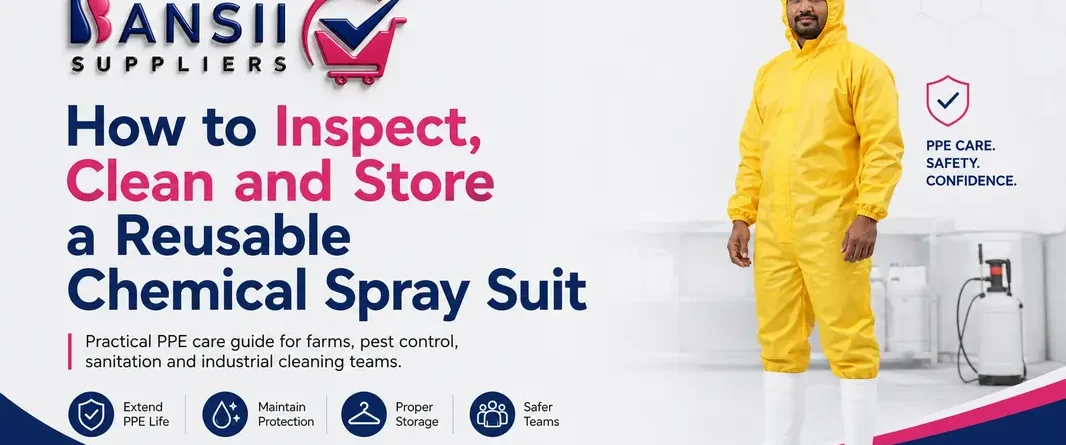
Reusable Chemical Spray Suit Care Guide: Inspection, Cleaning & Storage
Reusable chemical spray suits are used in selected agricultural spraying, pest-control, industrial cleaning and chemical-handling activities. However, proper maintenance is essential to preserving the protective performance of a garment.
A reusable suit must be suitable for the intended hazard and remain in acceptable condition throughout its service life. Damage, incorrect cleaning or chemical contamination can make it unsafe to reuse.
This guide explains how to inspect, clean, decontaminate, dry, store and replace reusable chemical spray suits in workplace PPE programmes.
What Is a Reusable Chemical Spray Suit?
A reusable chemical spray suit is protective clothing designed for repeated use when the manufacturer permits cleaning and reuse.
Depending on the model, it may feature a hood, protective body coverage, long sleeves, fitted cuffs and a front closure.
However, the term reusable does not mean a garment can be worn indefinitely or that it is suitable for every pesticide or industrial chemical.
The actual protection depends on its material, construction, chemical compatibility and documented performance.
Explore the Reusable Chemical Spray Suit Kenya product or visit our Protective Spray Suit Supplier Kenya page for corporate sourcing.
1. Inspect Your Spray Suit Before Every Use
Inspect reusable protective clothing before it is issued to a worker. Repeat the inspection after use and after cleaning, where required.
Pay particular attention to areas exposed to frequent movement, contact with equipment and chemical contamination.
| Inspection area | What to check |
|---|---|
| Garment material | Holes, cuts, tears, cracking, peeling or deterioration |
| Seams | Open stitching, damaged seam tape or visible gaps |
| Front closure | Damaged fasteners, broken zips or incomplete closure |
| Hood | Tears, stretching, damaged openings or poor fit |
| Wrist and ankle areas | Damaged cuffs, loss of elasticity or exposed gaps |
| Overall condition | Staining, contamination, unusual stiffness or material changes |
Do not issue a damaged or unsuitable spray suit to a worker.
Where a defect is found, remove the garment from service for assessment. Only use repair methods expressly approved for that particular product.
2. Remove Contaminated Spray Suits Carefully
A contaminated suit can transfer pesticide or chemical residues to the worker during removal.
Employees should follow their organisation’s approved PPE removal and decontamination procedure.
The procedure should address:
- Designated areas for removing contaminated PPE
- Any required surface decontamination before removal
- The correct sequence for removing the suit and supporting equipment
- Avoiding contact with contaminated outer surfaces
- Safe handling of used protective clothing
- Personal washing and hygiene requirements
- Reporting accidental exposure or garment damage
The correct sequence depends on the substance and other PPE being worn. Workers should receive practical training rather than relying on written instructions alone.
3. Understand Cleaning vs Decontamination
Cleaning and decontamination are related, but they are not necessarily the same process.
Cleaning removes dirt, visible residues and other material.
Decontamination reduces or removes hazardous contamination to the level required by the approved procedure.
A chemical spray suit may appear clean while still containing hazardous residues.
Before attempting decontamination, review the chemical involved, its concentration, the garment material, the Safety Data Sheet where applicable, and the manufacturer’s instructions.
If safe decontamination cannot be established, do not return the garment to service.
4. How to Clean a Reusable Chemical Spray Suit
There is no single cleaning method suitable for every reusable protective suit.
Follow the care instructions provided by the garment manufacturer and the workplace’s approved cleaning procedure.
A controlled cleaning programme may involve:
- Separating contaminated protective clothing from clean PPE.
- Moving used garments to an approved cleaning area.
- Wearing suitable protection during handling and cleaning.
- Applying the approved cleaning or decontamination procedure.
- Using only permitted cleaning agents and equipment.
- Rinsing where required by the approved procedure.
- Inspecting the garment after cleaning.
- Drying the garment according to the manufacturer’s instructions.
- Recording defects and withdrawing unsuitable garments.
Never wash contaminated spray suits together with household laundry, office uniforms or ordinary workwear.
Can Chemical Spray Suits Be Machine Washed?
Machine washing is acceptable only when the garment manufacturer expressly permits it.
Some protective materials, coatings or seams may be damaged by strong detergents, bleach, solvents, hot water, aggressive wash cycles or high-temperature drying.
If the manufacturer does not provide suitable machine-washing instructions, do not assume conventional laundry methods are safe.
5. Drying and Storing Reusable Spray Suits
Clean protective suits should be dried and stored according to the manufacturer’s instructions.
Suitable storage arrangements may include:
- A clean and dry PPE storage area
- Adequate ventilation
- Protection from excessive heat and sunlight
- Separation from chemicals and contaminated equipment
- Protection from sharp objects
- Clear identification of clean and approved garments
- Separate areas for items awaiting inspection or disposal
Do not place damp or contaminated suits directly into storage with clean protective equipment.
Avoid tightly folding or crushing garments where this could damage protective coatings or construction.
6. When Should a Reusable Chemical Spray Suit Be Replaced?
A reusable suit should be withdrawn from service when its condition, contamination history or manufacturer-defined service limits make continued use unsuitable.
Common warning signs include:
- Holes, cuts or punctures
- Torn seams or damaged closures
- Cracking or peeling protective material
- Loss of flexibility
- Worn or damaged cuffs
- Persistent or uncertain contamination
- Damage that cannot be repaired using an approved method
- Failure to meet manufacturer inspection requirements
A spray suit should not be reused simply because the damage appears minor.
The manufacturer’s care and service-life instructions should guide any decision to clean, repair, replace or dispose of a garment.
7. Keep a Spray Suit Inspection and Maintenance Record
Companies using reusable protective clothing can improve PPE management by keeping a straightforward inspection and issue record.
A useful record may contain:
| Record field | Information to capture |
|---|---|
| Suit identification | Model or assigned garment number |
| Employee or department | Worker or team using the suit |
| Date issued | Date supplied to the worker |
| Task and substance | Intended activity and chemical exposure |
| Inspection | Date, result and identified defects |
| Cleaning | Date and approved cleaning procedure |
| Status | Approved for use, awaiting assessment or withdrawn |
| Replacement | Replacement date and reason |
These records help safety teams monitor garment condition and help procurement departments plan suitable replacement stock.
8. Reusable Spray Suits for Flower Farms
Flower farms may use reusable protective suits in selected pesticide-handling and spraying programmes where the garment is suitable and the manufacturer supports safe reuse.
Before approving a suit, farm safety officers should assess the pesticide, concentration, worker task, application equipment, exposure conditions and protective-clothing specifications.
The programme should also address correct sizing, worker training, decontamination, storage and replacement procedures.
For garment selection, visit Pesticide Spray Suits for Flower Farms Kenya.
For the wider PPE requirement, explore PPE for Flower Farm Spraying Teams Kenya.
9. Supporting PPE for Chemical Spraying
A reusable protective suit is only one part of a worker’s protection.
Depending on the identified hazard, additional equipment may include:
- Safety Gloves Kenya — hand protection selected for the specific substance.
- Respirators Kenya — respiratory equipment matched to the airborne hazard.
- Eye Protection Supplier Kenya — goggles and other suitable eye or face protection.
- Safety Gumboots Supplier Kenya — protective footwear for appropriate workplace conditions.
All equipment must be selected for the intended task and checked for compatibility when worn together.
For broader requirements, visit Chemical PPE Supplier Kenya.
Frequently Asked Questions
How many times can a reusable spray suit be worn?
There is no universal number. Service life depends on the garment, exposure history, cleaning procedures, physical condition and manufacturer-defined limits.
Should a spray suit be cleaned after every use?
Follow the manufacturer’s instructions and approved workplace procedures. Contaminated garments must not be reissued without the required cleaning or decontamination.
Can a torn chemical spray suit be repaired?
Only where the manufacturer provides an approved repair procedure. Improvised patches or repairs should not be assumed to restore protective performance.
Can employees share reusable chemical spray suits?
Sharing requires an appropriate inspection, hygiene, cleaning and issue system. Each worker must also have a correctly sized garment.
Are reusable spray suits suitable for every pesticide?
No. Chemical compatibility and protection depend on the actual product, garment material, application method and exposure conditions.
Can reusable spray suits be machine washed?
Only if the manufacturer permits machine washing and provides suitable instructions.
Buy Reusable Chemical Spray Suits in Kenya
Bansi Suppliers supports companies, flower farms, pest-control contractors and industrial teams sourcing reusable protective suits and related workplace PPE.
For a quotation, provide your preferred garment specification, required quantities, employee sizes, intended application and delivery location.
You can also submit a complete PPE procurement requirement covering protective clothing, gloves, gumboots, respirators and eye protection.
Request a Corporate Quotation or Upload Your RFQ, BOQ or Procurement List.
Bansi Suppliers — Source. Supply. Succeed.